
Demystifying denials. The codes, and what they mean.
The most frustrating thing about denials is that they are rarely straightforward. The goal at ROI is to help you build frameworks that work for any situation. Understanding how adjustment codes are built is the first step to creating a framework that works for you instead of against you.
The codes that provide the details about each adjustment come in 2-3 parts. The first two parts are required (the group code, and the CARC). The third part is supplemental (the RARC) and only required in some situations. Keep in mind that not all adjustment codes are denials. Some just indicate standard contractual adjustments, or patient responsibility. The same 2-3 part format, and the definitions listed below will still apply. The only thing that changes is how you handle it. Keep in mind, even something that appears to be a standard contractual adjustment might be hiding an underpayment, so always verify the payment amount is correct before posting.
Part 1: Key Terms
What is a CARC, what is a RARC, and how are they different?
Claim Adjustment Reason Code (CARC)
CARCs are used to communicate the high-level reason, or the category of denial. They explain why a claim or service line was paid less than was expected, but they do not always provide the full detail. Most CAN come with additional information in the form of a RARC, and some are REQUIRED to be reported with a RARC, such as CARC 16.
Remittance Advice Remark Codes (RARC)
RARCs are supplemental alpha-numeric codes that provide additional clarity to help you understand what the CARC code means. For example, CARC 16 on its own means "Claim/service lacks information or has submission/billing error(s)" which is not terribly helpful, but with a RARC such as M20, you know that the issue is there is a missing or invalid HCPCS on the claim.
The main difference between a CARC and a RARC is the level of detail. Think of the CARC as the folder, and the RARC as the files that live inside the folder. If the CARC tells you the claim is denied because something is missing, you need the RARC to tell you WHAT is missing.
If the RARC indicates that there is a missing modifier, then your next step is to figure out what to do to correct it.
Using our folder analogy, you would look under the "Missing Information" folder, find the file that says "Missing modifier" and read the instructions about how to correct that denial.
Federal auditors reviewed a sample of Medicare Advantage denials and found that 13% of denied prior authorization requests and 18% of denied payment requests actually met Medicare coverage and billing rules. The claims were payable; the denial was wrong.
Source: HHS Office of Inspector General, April 2022, OEI-09-18-00260. Based on stratified samples of 250 prior authorization denials and 250 payment denials from the 15 largest MA organizations, June 1–7, 2019.
Mindy Corbett, CSPO, CPC, CPB, CPPM, founder of ROI That Works: “The CARC tells you which bucket the payer put your claim in. The RARC tells you what they actually want. Appeals that answer the remark code get read; appeals that argue with the category do not.”
What is a group code, and what does it mean?
Contractual Obligation (CO)
This group code is used for any amounts that are considered the financial liability of the provider. In most cases, this is a predetermined, contracted adjustment amount based on an agreed upon fee schedule. However, this group code is also used when a service is denied. CO-45 adjustments that are for the agreed correct, contracted amount should be posted. Any that are incorrect should be treated as an underpayment or denial and researched. Any other adjustments with a CO group code that do not appear to be correct should be investigated.
Patient Responsibility (PR)
This amount has been determined by the payer to be the responsibility of the patient. This typically includes amounts such as the patient's copay, coinsurance, unmet deductible amounts and services not covered under the patient's plan.
Other Adjustments (OA)
This means neither the provider or patient is liable for the amount. However, it does often indicate that the claim needs to be reviewed. Most commonly this group code appears with CARC 18 or 23.
Payor Initiated Reduction (PI)
This is generally used when a payer decides based on their own findings (not based on the contract). These are usually for payer review findings such as medical necessity denials, regulatory penalties, utilization review denials, and other similar situations. You cannot bill the patient for these. These are often appealable, but if they are not the provider absorbs the cost.
Part 2: Anatomy of an ERA
Your EHR should allow you to see the CARC and RARC codes in the claim or remit information. However, there are some situations where the EHR suppresses the RARC or makes it difficult to find. If that is the case for you, please reach out to your EHR help desk to get help locating that field or making sure that it is not suppressed because it is critical to understanding many denials.
If necessary, you can find the information you need from the raw ERA file.
ERAs are organized by segments, and each segment is split by data element separators (generally a "*") which is used to split different pieces of the same segment. Each segment ends with a segment terminator. In most cases, this is a "~." As an example of what that would look like, the CLP segment contains up to 14 elements. In most cases this segment will contain a "Patient Control Number," which is the claim ID that was submitted on the claim from the provider, a claim status code, a claim charge amount, a claim payment amount, a patient responsibility amount, and a claim filing indicator code. This would look like: CLP*CLM0000000*1*500*250*10*1~
Common delimiters and separators found on ERAs
| Delimiter | Character Used | Purpose |
|---|---|---|
| Data Element Separator | * | Separates elements that are part of the same segment (e.g. Billed*Paid*Patient Resp) |
| Segment Terminator | ~ | Signifies the end of a segment |
The Group Code and the CARCs are located in the CAS segment. Look for "CAS" followed by a "*". Then you should see the group code. After the next element separator, you will see the group code, followed by the next element separator then the CARC, another element separator then the adjustment amount.
The RARC is in either the MOA segment for outpatient claims, the MIA segment for inpatient claims, or the LQ segment. The MOA and MIA segments will show the adjusted amount first, with the RARC at the end of the segment. The LQ segment will show just the RARCs. In any of the three segments, if there is more than one RARC, they will be listed sequentially (e.g., M20*M24*N295~).
ERA examples
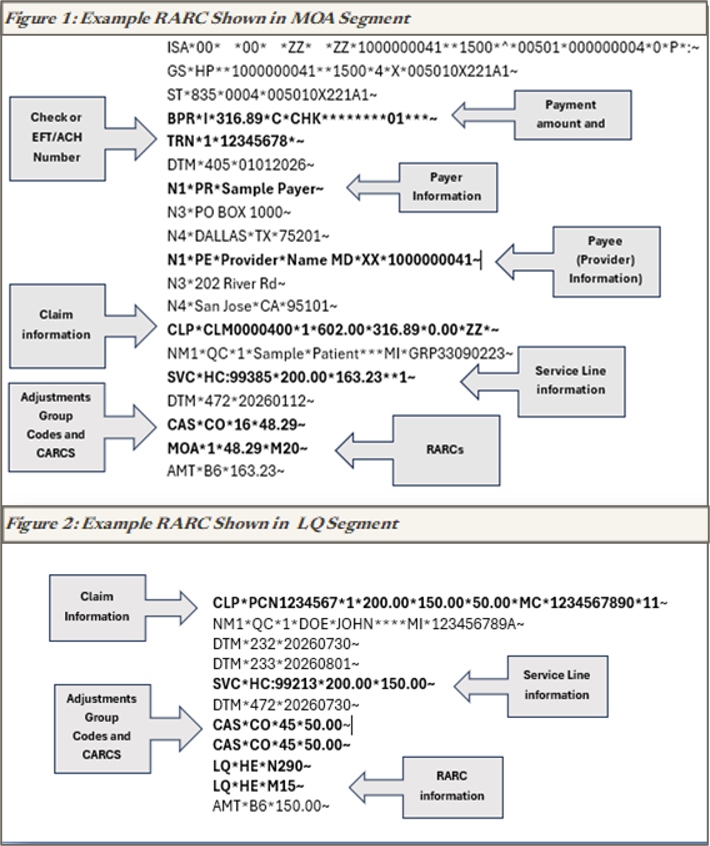
Figure 1: RARCs in MOA segment · Figure 2: RARCs in LQ segment
Real world CARC and RARC pairings
CARC 50 + RARC N115
CARC 50: These are non-covered services because this is not deemed a 'medical necessity' by the payer. + RARC N115: This decision was based on a Local Coverage Determination (LCD). An LCD provides a guide to assist in determining whether a particular item or service is covered. A copy of this policy is available at www.cms.gov/mcd, or if you do not have web access, you may contact the contractor to request a copy of the LCD.
What does this mean? Based on a Local Coverage Determination (LCD) by your Medicare Administrative Contractor (MAC), the billed service is considered not medically necessary. These policies can be found on your MAC's website. They are typically under "Medical Policy/LCDs" or something similar. In order to request a redetermination or file any type of appeal you will need to fully understand the applicable policy, and gather all supporting documentation, including policy text.
To access a list of all CMS MACs and to learn more about LCDs, CMS provides more information here: https://www.cms.gov/medicare/coverage/determination-process/local.
CARC 96 + RARC N130
CARC 96: Non-covered charge(s). At least one Remark Code must be provided + RARC N130: Consult plan benefit documents/guidelines for information about restrictions for this service.
What does this mean? Check the patient's policy. This generally means that something about this service is excluded under their plan.
CARC 16 + RARC N290
CARC 16: Claim/service lacks information or has submission/billing error(s) + RARC N290: Missing/incomplete/invalid rendering provider primary identifier.
What does this mean? The primary identifier that should be on the claim was missing, incomplete or invalid. The primary identifier is the billing or rendering Tax ID or NPI that the payer recognizes as the ID enrolled with the plan or the ID they expect to see on the claim.
CARC 16 + RARC N288
CARC 16: Claim/service lacks information or has submission/billing error(s) + RARC N288: Missing/incomplete/invalid rendering provider taxonomy.
What does this mean? This could mean a few different things. For example, it could mean that the taxonomy code for the rendering provider was not on the claim, or the taxonomy code does not match the specialty of the provider on file with the payer, it was entered incorrectly, there was a technical issue that resulted in the taxonomy code not transmitting, or the payer could have outdated information. Regardless, this requires review.
Common pairings
| Group | CARC | RARC | CARC Meaning | RARC Meaning |
|---|---|---|---|---|
| CO | 4 | N519 | The procedure code is inconsistent with the modifier used | Invalid combination of HCPCS modifiers |
| CO | 11 | M76 | The diagnosis is inconsistent with the procedure | Missing/incomplete/invalid diagnosis or condition |
| CO | 16 | M51 | Claim/service lacks information or has submission/billing error(s). At least one Remark Code must be provided | Missing/incomplete/invalid procedure code(s) |
| CO | 16 | N290 | Claim/service lacks information or has submission/billing error(s). At least one Remark Code must be provided | Missing/incomplete/invalid rendering provider primary identifier |
| CO | 16 | N297 | Claim/service lacks information or has submission/billing error(s). At least one Remark Code must be provided | Missing/incomplete/invalid supervising provider primary identifier |
| CO | 16 | N822 | Claim/service lacks information or has submission/billing error(s). At least one Remark Code must be provided | Missing procedure modifier(s) |
| OA | 18 | N522 | Exact duplicate claim/service (Use only with Group Code OA except where state workers' compensation regulations requires CO) | Duplicate of a claim processed, or to be processed, as a crossover claim |
| OA | 22 | MA04 | This care may be covered by another payer per coordination of benefits | Secondary payment cannot be considered without the identity of or payment information from the primary payer. The information was either not reported or was illegible |
| PR | 27 | N30 | Expenses incurred after coverage terminated | Patient ineligible for this service |
| CO | 29 | N211 | The time limit for filing has expired | Alert: You may not appeal this decision |
| CO | 31 | N382 | Patient cannot be identified as our insured | Missing/incomplete/invalid patient identifier |
| CO / PR | 50 | N115 | These are non-covered services because this is not deemed a 'medical necessity' by the payer | This decision was based on a Local Coverage Determination (LCD). An LCD provides a guide to assist in determining whether a particular item or service is covered |
| CO / PR | 96 | N425 | Non-covered charge(s). At least one Remark Code must be provided | Statutorily excluded service(s) |
| CO | 97 | M144 | The benefit for this service is included in the payment/allowance for another service/procedure that has already been adjudicated | Pre/post-operative care payment is included in the allowance for the surgery/procedure and is not paid separately |
| CO | 97 | M15 | The benefit for this service is included in the payment/allowance for another service/procedure that has already been adjudicated | Separately billed services/tests have been bundled as they are considered components of the same procedure. Separate payment is not allowed |
| CO | 97 | N19 | The benefit for this service is included in the payment/allowance for another service/procedure that has already been adjudicated | Procedure code incidental to primary procedure |
| OA | 109 | N418 | Claim/service not covered by this payer/contractor. You must send the claim/service to the correct payer/contractor | Misrouted claim. See the payer's claim submission instructions |
| CO | 119 | N362 | Benefit maximum for this time period or occurrence has been reached | The number of Days or Units of Service exceeds our acceptable maximum |
| CO | 151 | N362 | Payment adjusted because the payer deems the information submitted does not support this many/frequency of services | The number of Days or Units of Service exceeds our acceptable maximum |
| CO | 197 | M62 | Precertification/authorization/notification/pre-treatment absent | Missing/incomplete/invalid treatment authorization code |
| CO | 197 | N54 | Precertification/authorization/notification/pre-treatment absent | Claim information is inconsistent with pre-certified/authorized services |
| PR | 204 | N130 | This service/equipment/drug is not covered under the patient's current benefit plan | Consult plan benefit documents/guidelines for information about restrictions for this service |
| CO | B7 | MA120 | This provider was not certified/eligible to be paid for this procedure/service on this date of service | Missing/incomplete/invalid CLIA certification number |
| CO | B7 | N570 | This provider was not certified/eligible to be paid for this procedure/service on this date of service | Missing/incomplete/invalid credentialing data |
Frequently asked questions
What is the difference between a CARC and a RARC on an ERA?
Think of the CARC as the category and the RARC as the detail. You often need both. The RARC supplements the CARC. The CARC gives you the broad strokes, such as "This claim is missing something" but the RARC tells you WHAT that is like "This claim is missing a modifier." A good example is the CARC/RARC pair CARC 16 + RARC N290. CARC 16 is an administrative denial that means something is missing or incorrect on the claim. The RARC tells you what. In our example, the RARC indicates that something is wrong with the primary identifier on the claim.
CARCs will sometimes appear without a RARC, but RARCs should never appear alone.
Why does the group code matter?
The group code is often overlooked in cheat sheets, and other "helpful" tools posted online. This leads to some misunderstanding about what group codes are, how they work, and what they mean. For example, CARC 18 should only be reported with group code "OA" unless state work comp regulations require "CO." However, cheat sheets constantly show CARC 18 as "CO-18" which is fundamentally wrong and sets the wrong tone.
The group code tells you who is financially responsible. The way you handle an adjustment code that has a PR group code is different than how you would handle one with a CO group code. If you are treating them all as "CO" you run the risk of writing off balances that can be billed to the patient, or billing patients for balances that they are not contractually responsible for.
Can a claim have more than one CARC? What about RARCs?
Absolutely. There can be multiple CARCs per CAS segment, but for clarity there usually are not more than a few and typically not more than one or two. For RARCs, most payers report one RARC per LQ or MOA segment, but some do include more, if they have more than one related remark. The maximum number depends on the payer.
Do all payers use the same CARC and RARC codes?
CARC and RARC codes are standardized, but payers sending paper EOBs will sometimes send non-standard adjustment codes. Electronic remits (835/ERA files) should have standard CARC/RARC codes.
Code set standards, updates and versions are maintained by X12, with some code specific updates managed by X12 Code Maintenance Groups (CMG). CMG maintains CARCs and CMS maintains RARCs. Compliance, obsolete code deactivation, and update notices are handled by CMS. Metadata and electronic health interoperability (FHIR alignment) is maintained by HL7 TSMG.
Where can I look up any CARC or RARC?
ROI's EDI Lab contains a full library of CARC and RARC codes with descriptions, action plans, appeal tips, and prevention strategies. The official lists can be found at x12.org/codes/claim-adjustment-reason-codes and x12.org/codes/remittance-advice-remark-codes.
Look up any CARC, RARC, or group code
The EDI Lab lets you search the full published code set with plain-English explanations, action steps, appeal guidance, and prevention notes. Built to be used at the desk while a claim is open.
Open the EDI Lab →Sources
- X12 Claim Adjustment Reason Codes. Authoritative CARC list maintained by the X12 External Code List Subcommittee.
- X12 Remittance Advice Remark Codes. Authoritative RARC list, maintained by CMS as the national code list maintainer.
- CMS Transmittal 2372 · Medicare Claims Processing Manual, Publication 100-04. Establishes required use of CARCs and RARCs on the 835 ERA and the standard paper remittance.
- CAQH CORE Phase III 360 Uniform Use of CARCs and RARCs (835) Rule. Operating rules for how group codes, CARCs, and RARCs must appear together on remittance advice.
- X12 · 835 Health Care Claim Payment/Advice Technical Report Type 3 (TR3). Official 835 companion guide with segment definitions for CLP, SVC, CAS, MOA, MIA, and LQ.
- WPS Government Health Administrators · Reason/Remark Code Lookup. Practical lookup tool for CARC and RARC narratives.