
 Revenue Optimization & Intelligence · roithatworks.com
The Dispatch
A monthly briefing on denial patterns, appeal strategy, and payer policy. The fix, not the fear.
95 percent of appealed skilled nursing denials were overturned. Only 18 percent were ever appealed.
In June, the HHS Office of Inspector General published two reports that quietly reset the conversation on Medicare Advantage. The three largest MA plans denied long-term acute care admissions at rates between 71 and 80 percent. When providers actually appealed, 36 to 95 percent of those denials were overturned. That is not a claims problem. That is a strategy problem, and it is worth real money on your bottom line. And here is the part the headline hides: skilled nursing was the setting these plans denied the least. The full picture below is worse.
Welcome to Issue 01. Every month: one denial pattern, one EDI Lab walkthrough, one appeal anatomy, one policy watch. No filler. Here is how to work this one before Labor Day.

What the OIG actually found, and why the numbers are cleaner than they look.
Two reports, released June 11, 2026. OEI-09-24-00330 covered long-term acute care (LTCH) and inpatient rehab (IRF) admissions. OEI-09-24-00331 covered skilled nursing (SNF). Nineteen Medicare Advantage organizations were reviewed, covering 86 percent of MA enrollment. Across the two reports, roughly 132,000 post-acute prior authorization requests were examined. About 26,000 were denied.
That is money that walked out the door on procedure alone. The 18 percent appeal rate is not accidental.
There is a teachable point in this, but it is not what you think. It is not "send more appeals." It is learning to determine which denials are procedural, which are policy, and which are just wrong, then categorizing and prioritizing them so you are filing the right appeals. Then it is automated workflows that sort denials into those categories so nothing falls through the cracks. If you are sorting by the adjustment code alone, without an actionable process behind it, you will have leaks.
Medical necessity denials. Appeal tips and prevention strategies.
Most of the time, the adjustment code on a medical necessity denial is going to be Claim Adjustment Reason Code (CARC) 50. Typically, it will come with group code "CO" so it will appear as "CO-50" on your remit. The CARC alone is only half of the story. The full story relies on the RARC (Remittance Advice Remark Code) that follows it. If you are approaching medical necessity denials by working the CARC code alone, then you are missing half of the information you need to appeal it effectively.
N115 is an LCD-based decision, N386 is NCD-based, and N130 points to the payer plan policy. Your documentation and appeal needs to support the named policy. If it does not, you will not win the appeal.
LCDs and NCDs are on the CMS Medicare Coverage Database. MA and commercial policies are on the payer portal. Print it. Highlight every "must," "shall," and "will." SAVE IT. You will need it again.
Five criteria in the policy means five sections in your letter, each quoting the chart line that proves the criterion is met.
If the plan applied criteria more restrictive than Traditional Medicare, cite 42 CFR 422.101(b). That is a regulatory violation, not a coverage disagreement.
Pull your ten oldest post-acute MA denials and sort them into three piles: true denial, information request, billing error. Only pile one gets an appeal.
For every medical necessity denial, write down the RARC beside it and the document or policy it references (e.g., LCD, NCD, or payer policy). Save those documents, and make them available to your team.
Divide appeals filed by denials received for the last quarter. If your rate is anywhere near the OIG's 18 percent, you most likely have recoverable revenue. Go after it.
Are you stuck on any denials? Send me an email with the codes you need help with, and I will point you to the resolution path.
The same denial. Every code, every combination.
The same denial, in ROI's EDI Intelligence Lab. Every code, every combination, with the action plans, appeal tips, and prevention strategies that go with them. Enter your adjustment code, complete the story by entering your remark code, and get everything you need to understand how to appeal the denial now and prevent it in the future.
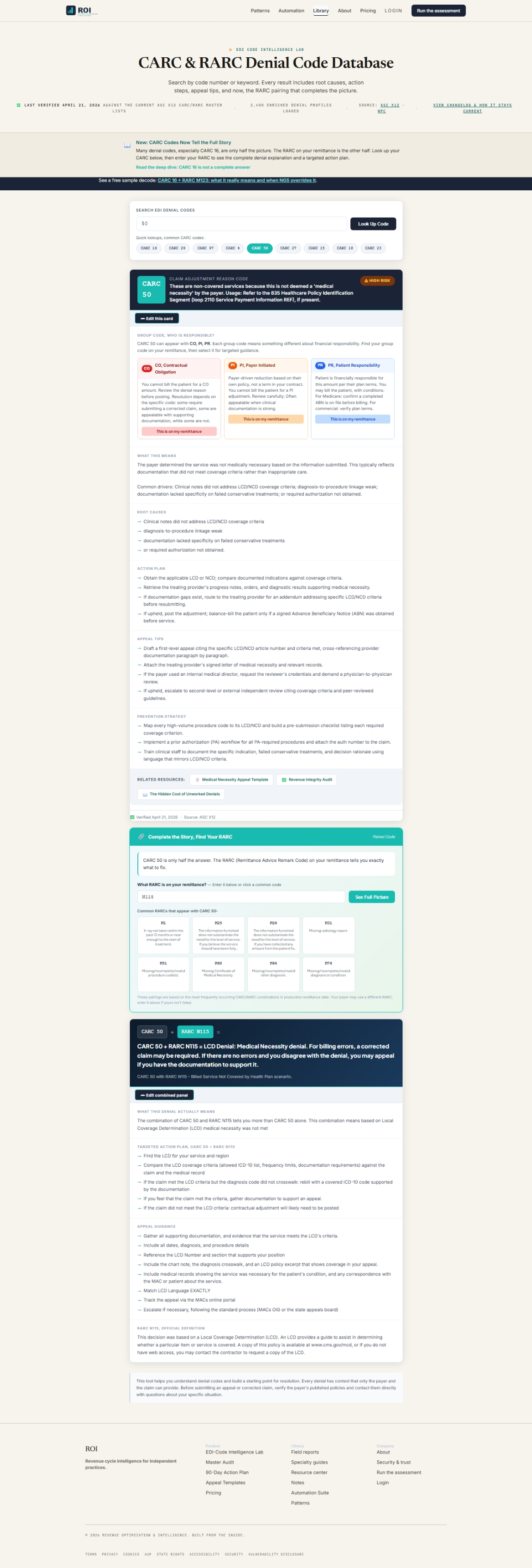
What a first-level appeal looks like when it actually overturns these denials.
A merit-based first-level appeal is a specific document. The sections have to be there for the reviewer to engage with them.
This letter is not a re-litigation of the clinical decision. It defends the documentation of the decision against the specific criteria the plan cited. Stay in that lane and your overturn rate will move.
The full anatomy, with worked examples for medical necessity, prior authorization, timely filing, and the bundling and modifier family, is in the appeal-letter hub. Downloadable templates are in appeal templates.
CMS finalized the 2027 Medicare Advantage rate notice, which included clarifications on non-covered service handling under the ADA. Watch for CARC 96/204 patterns on dental-adjacent claims where medical necessity is documented.
Several commercial plans extended gold-carding programs to include additional post-acute specialties. If you have not audited which of your providers qualify in the past 90 days, do it this week.
CMS is accepting comments on a proposed rule that would tighten the standard for retrospective denials in Medicare Advantage. If you have data on retrospective denials, this is the comment window that matters. Your billing team has the data. Submit it.
WISeR is live in six states. What to have in place before it expands: current auth workflow documented, retrospective denial rate tracked, appeal letter templates ready for the specific denial families WISeR is generating.
If you see one of these patterns on your remits, start with the assessment.
Seven questions, two minutes, no PHI. It surfaces the specific denial families you are losing money to. If you already know what you are dealing with, the Lab, the templates, and the audit workflow are in one place.
If a specific denial pattern is hitting your practice hard, reply to this issue and tell me. That is how I decide what to cover next.